Miniatures
Mads Emil Dreyer
Miniatures
Scenatet, EKKI MINNA, Athelas Sinfonietta
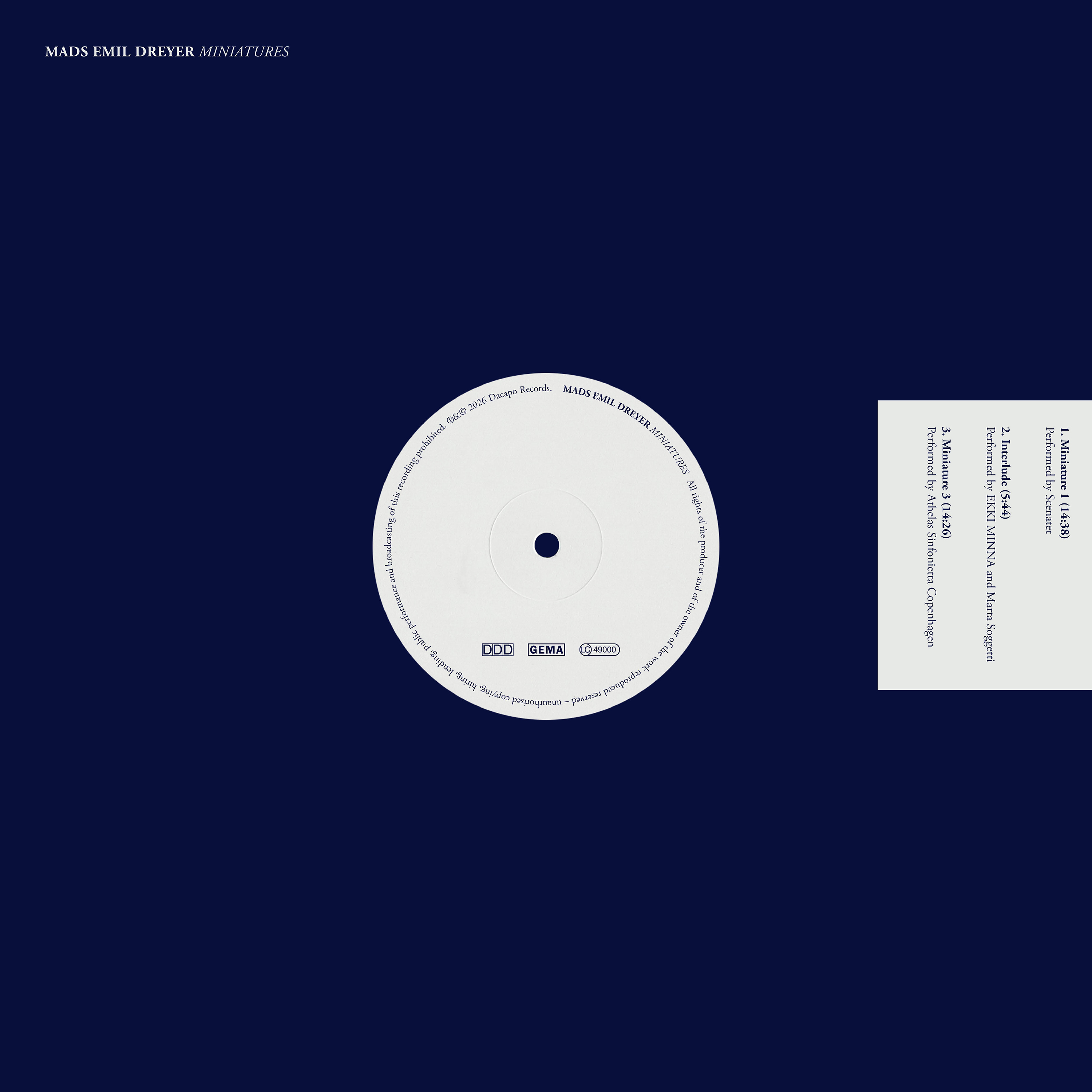
In his Miniatures series, Danish composer Mads Emil Dreyer explores the uncanny gap between acoustic and electronic sound. Pairing glockenspiels and strings with ‘shadow’ sine tones via transducers, Dreyer creates a hybrid soundworld of shimmering, fuzzy beauty. Like Monet’s cathedral paintings, these works view a central object through changing light and weather. From intimate quartets to chamber orchestration, this is music of childlike innocence haunted by a dark, synthetic presence.
World premiere recording. Released as a digital-only album.
Buy album
Stream
Download
-
mp3 (320kbps)69,00 kr.mp3€9.23 / $10.86 / £7.98Add to cart
-
FLAC 16bit 44.1kHz79,00 kr.CD Quality€10.57 / $12.43 / £9.14Add to cart
-
FLAC 24bit 96kHz105,00 kr.Studio Master€14.05 / $16.53 / £12.14Add to cart

© Asta Cornelius
SELECT PREFERRED FORMAT TO DOWNLOAD SINGLE TRACKS.
| 1 | I. | 3:30 |
8,00 kr.
€1.07 / $1.26 / £0.93
|
||
| 2 | II. | 3:08 |
8,00 kr.
€1.07 / $1.26 / £0.93
|
||
| 3 | III. | 3:56 |
8,00 kr.
€1.07 / $1.26 / £0.93
|
||
| 4 | IV. | 4:01 |
8,00 kr.
€1.07 / $1.26 / £0.93
|
| 5 | – | 5:44 |
12,00 kr.
€1.61 / $1.89 / £1.39
|
| 6 | I. | 4:30 |
8,00 kr.
€1.07 / $1.26 / £0.93
|
||
| 7 | II. | 3:17 |
8,00 kr.
€1.07 / $1.26 / £0.93
|
||
| 8 | III. | 6:37 |
12,00 kr.
€1.61 / $1.89 / £1.39
|
Album introduction
Darkness visible: Mads Emil Dreyer’s Miniatures
By Tim Rutherford-Johnson
Mads Emil Dreyer often works in series. He finds it helpful to consider any individual work as not necessarily conceptually complete, but as one chapter within a potentially ongoing story.
As a listener or viewer, one of the pleasures of artistic works that are made in this way is the game of identifying the points of connection and difference that make a series of works both coherent and divergent, and then inferring from connections and differences something of what the work means, what the artist values, and how they view the field of possibilities in which the series sits. Monet’s more than thirty paintings of Rouen cathedral, to take a famous example: although the subject, viewpoint and scale remain constant, the different seasons, times of day and weather conditions lead us to believe that Monet’s interest is not so much in medieval religious architecture, but in how changes in light can alter both the appearance and emotional effect of the things we see.
On a surface level, what connects the Miniatures on this recording is their use of glockenspiels paired with electronic keyboards as a kind of hybrid continuo instrument. In Miniature 1 (2021), the template for the series of works that follows in its name, a quartet of musicians sits with a pair of these instruments each, which they play simultaneously. With their right hand, a toy glockenspiel; with their left, a keyboard. The keyboard sends out sine tones to a small speaker (known as a transducer) that is attached to the body of the glockenspiel: when a note is played, the sine tone both sounds itself and sympathetically resonates the metal bars of the glockenspiel. Where Miniature 1 is for just four such musicians, Miniature 3 (2021) partners two glockenspiel/keyboard players with a chamber orchestra of thirteen musicians. And Interlude (2025) presents one in a trio with cello and accordion. Each one a setting of the same object at a different time of day or in a different type of weather.
But why ‘miniatures’? Presumably, the series’ title points towards something that ties its pieces together. A collection of short movements for a quartet of toy glockenspiels might be described as ‘miniature’ in many ways: by the ‘smallness’ of its soundworld or the compactness of its instruments, say. And certainly by its evocation of a childhood memory of a tiny ballerina inside a wind-up music box. That accounts for Miniature 1, at least. But with Miniature 3, and the addition of a chamber orchestra, do those associations still hold up? Probably not. And in any case, although none of these three pieces is exactly symphonic, neither do they unfold with the single, swift gesture of a bagatelle or epigram. They take their time, relishing every slight change in harmonic or rhythmic pattern. If these are miniatures in that sense, they are lugubrious ones, at best.
A little further down the series, in Miniature 6 (2023) – not recorded here – we get further clues as to the meaning of that title. (It is a feature of series that as they go on, they both widen their range of expression and clarify their central core.) For one thing, Miniature 6 is the first piece in the series not to feature glockenspiel at all – so the connection runs deeper than the music box-y sound it suggests. Instead, transducers are attached to the bodies of an accordion and a cello, and play sine tones that the players activate with foot pedals. And in the front of this score, Dreyer explains (for the first time), ‘This piece is number six in my Miniatures series, wherein I’m aiming at hiding, or even eliminating, the gap between acoustic and electronic sound sources’.
‘Miniature’, then points to the musical relationship between notes played on acoustic instruments and those by their electronic shadow. Although each musician plays their acoustic and electronic instruments simultaneously (in the case of Miniature 1, this means playing the glockenspiel and keyboard together), they are not quite in unison. The sine tones are tuned a fraction off – less than a tenth of a semitone – from the glockenspiels. This tiny gap between the notes played on the acoustic instrument and its electronic shadow is thus our ‘miniature’: a liminal space, a sliver of distance between ‘real’ and ‘synthetic’.
On Miniature 1, the tuning difference is barely enough to make out, except for the faint shimmering or buzzing quality it adds to the glockenspiel chimes as the two out-of-phase wave patterns interact. It adds a specific colour to the sound, gives the music a slightly fuzzy, unreal quality. But on Interlude and Miniature 3, it offers a passageway to wider compositional exploration. It is as if, having found within an otherwise perfect diamond a tiny flaw that scatters the light in unusual ways, Dreyer has magnified that flaw until the scattered rays become more significant than the gemstone itself.
On Interlude, those rays are the accordion and cello, which play long tones (coloured by a transducer/foot pedal set-up like that employed in Miniature 6) that give body to the faint buzzing echoes of the glockenspiel, extending them, thickening them and bringing them forth as musical material in their own right. On Miniature 3, not only do a greater number of instruments contribute to a greater ‘fleshing out’ of the rays, but their diversity and distribution across the stereo field of the recording acts like a prism, splitting the light into many different colours. Or, to put it another way, the music effects a kind of ‘dissection’ of itself, even as it is coming together.
Glinting diamonds or dissected bodies: there is always a mix of light and dark in Dreyer’s music. In his Forsvindere series, the music’s fairy tale-like quality (this time provided by chiming celesta and vibraphone) is undercut by an uncanny electronic backdrop of live loops and samples that, again, is designed to sit just beyond the reach of the live instruments. It is a flickering presence visible just on the edge of sight. In the Miniatures series, however, that uncanny presence is made almost entirely congruent with ourselves: the electronics perform just the subtlest, most disconcerting slip of time. It is as if our own universe has been overlaid by another, ever so slightly out of synch, so that we are haunted by a trailing version of ourselves just a beat or two behind; a presence we can neither touch nor control. Dreyer’s Miniatures may begin in childlike innocence, but as any child knows: beware of shadows.
© Tim Rutherford-Johnson, 2026
Tim Rutherford-Johnson is a writer with a focus on new music. He is the author of the widely praised Music after the Fall(University of California Press) and The Music of Liza Lim(Wildbird), and has co-authored Twentieth-Century Music in the West (Cambridge University Press).
Array
(
[da] => Array
(
[0] => Array
(
[fid] => 66906
[uid] => 8769
[filename] => DAC-DA2070_book.pdf
[uri] => public://texts/DAC-DA2070_book.pdf
[filemime] => application/pdf
[filesize] => 2739990
[status] => 1
[timestamp] => 1770285448
[origname] => DAC-DA2070_book.pdf
[focal_point] =>
[display] => 1
[description] => Booklet
)
)
[en] => Array
(
[0] => Array
(
[fid] => 66907
[uid] => 8769
[filename] => DAC-DA2070_book.pdf
[uri] => public://texts/DAC-DA2070_book_1.pdf
[filemime] => application/pdf
[filesize] => 2739990
[status] => 1
[timestamp] => 1770285499
[origname] => DAC-DA2070_book.pdf
[focal_point] =>
[display] => 1
[description] => Booklet
)
)
)